Winder Stair Calculator - L-Shaped Winder Treads in 3D
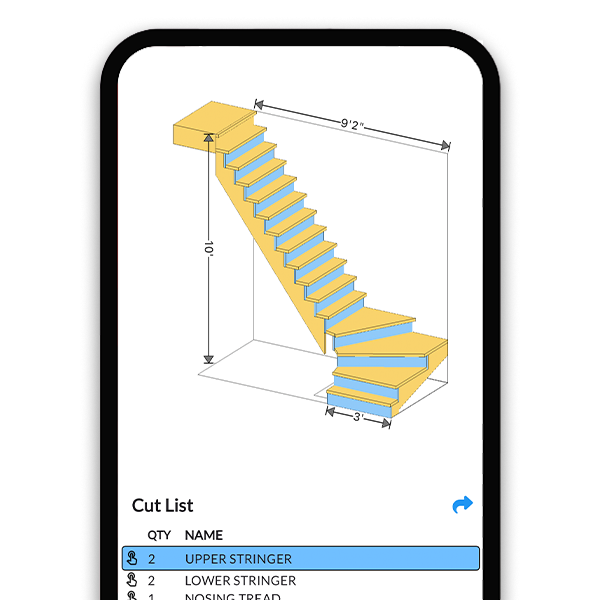
Master the art of winder stair construction with our Online 3D L-Shaped Winder Stair Builder. This advanced tool allows you to fully customize your quarter-turn winder stairs, adjusting every detail to suit your specific project needs. View and refine winder tread blueprints, and access beautifully designed overall blueprints along with detailed stringer plans. Our interactive 3D viewer ensures you can visualize and tweak your design in real-time, guaranteeing that every aspect of your stair meets both functional and aesthetic requirements.
How to Use This Tool
Enter rise and position the winder turn
Type in the total rise and place the 90 degree winder turn where the landing would otherwise go. The builder splits risers across the lower flight, the winder treads, and the upper flight, keeping every riser identical.
Set the winder tread count
Choose two or three winders in the turn - three is standard for a quarter turn at 30 degrees each. The tool computes each tread's depth at the 12 inch walkline and flags anything under the 10 inch code minimum.
Review winder tread blueprints
Open the winder tread blueprint view: each angled tread gets its own dimensioned template with the exact cut angles, so you can transfer the shapes straight to your tread stock.
Export the full plan set
Export or print the overall blueprint, stringer plans, and winder tread templates as PDFs, plus the complete cut list for both flights and the turn.
Winder walkline math
Riser count works like any stair - total rise / 7.5, rounded - but the turn replaces a flat landing with treads that keep climbing while rotating 90 degrees.
Code measures winder depth at the walkline, 12 inches from the narrow edge. Each winder must be at least 10 inches deep there and at least 6 inches at the narrowest point. For a quarter turn split into three 30 degree winders, the walkline depth is the arc length at the walkline radius - larger turns or fewer winders mean deeper treads at the line.
total risers = round(total rise / 7.5)
degrees per winder = 90 / number of winder treads
walkline depth = (degrees per winder x pi / 180) x (narrow-edge offset + 12 in)
code: walkline depth >= 10 in, narrow edge >= 6 in
Frequently Asked Questions
What is a winder stair?
A stair that turns a corner using wedge-shaped treads instead of a flat landing, so it keeps climbing through the turn. An L-shaped winder turns 90 degrees, typically with three treads of 30 degrees each. Winders save roughly a landing's worth of floor space - about 9 square feet on a 36 inch stair - which is why they are everywhere in older homes and compact plans.
What are the code requirements for winder treads?
The IRC requires each winder to be at least 10 inches deep measured at the walkline - 12 inches from the side where the treads are narrower - and at least 6 inches deep at the narrowest point. Riser heights across the whole stair, winders included, must stay within 3/8 inch of each other. These are the base IRC numbers; local amendments vary, so verify with your building department.
How many winder treads should be in a 90 degree turn?
Three winders at 30 degrees each is the standard and usually the most comfortable - it keeps the walkline depth generous without any single tread rotating too sharply. Two winders at 45 degrees each are legal if they still hit 10 inches at the walkline, but each step swings your foot through a bigger angle. The builder recalculates walkline depth instantly when you change the count.
Are winder stairs safe?
Built to code, yes - the 10 inch walkline rule exists precisely so a person walking the natural line through the turn always finds full tread depth. The hazard is the narrow inside edge, which is why a continuous handrail on the narrow side matters and why some builders keep the inside corner at 6 inches or more. Consistent risers through the turn are the other non-negotiable.
How do I cut winder treads accurately?
From templates. Each winder is a unique wedge with specific angles, so trying to lay them out with a framing square on site invites cumulative error. The builder produces a dimensioned blueprint for every individual winder tread - edge lengths and corner angles - that you can print, trace onto stock or cardboard first, and test-fit before cutting the finished treads.
Winder versus landing - which should I choose?
Choose a landing when you have the floor space: it is simpler to frame, easier to carry furniture around, and gives a resting point. Choose winders when the plan is tight - they recover about 36 inches of run that the landing would consume. Cost is close to even; winders trade landing framing for careful tread work. Compare both in minutes using this tool and the L-Shaped Stair Builder.