
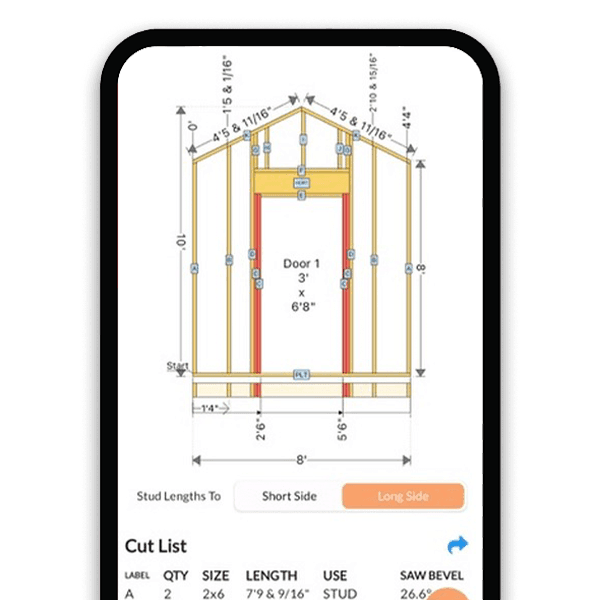
Rake Wall Framing - How to Frame a Gable End Wall
What is a Rake Wall?
A rake wall is a framed wall where the top plate is angled to follow the slope of the roof. You find rake walls at the gable ends of buildings - the triangular or trapezoidal sections where the wall rises from the eave height to the roof peak. The term "rake" comes from the sloped edge of the roof that the wall follows.
What makes rake walls challenging is that every stud has a different length. In a standard wall, you cut all studs to the same height. In a rake wall, each stud is progressively taller (or shorter) as you move along the wall, and each one needs a bevel cut at the top to sit flush against the angled top plate. Getting even one stud length wrong means recutting lumber and wasting material.
Rake walls are also called gable walls, gable-end walls, or pitched walls. The same framing principles apply to stair rake walls, where the wall follows the angle of a staircase instead of a roof.
Rake Wall vs Gable Wall - What is the Difference?
There is no structural difference - a rake wall and a gable wall are the same thing. Both terms describe a wall with an angled top plate that follows the roof slope at the end of a building. "Gable wall" refers to the wall under the gable (the triangular portion of the wall between the eaves and the ridge). "Rake wall" refers to the same wall following the rake (the sloped edge of the roof). Builders use both terms interchangeably.
The framing is identical: angled top plate, individually calculated stud lengths, bevel cuts matching the roof pitch, and standard bottom plate and stud spacing. Whether you call it a rake wall or gable wall, the math and the construction process are the same.
How to Calculate Rake Wall Stud Lengths
Every stud in a rake wall has a different length because the top plate is angled. Calculating each one by hand is tedious - a wall with 15 to 20 studs means 15 to 20 individual measurements, and getting one wrong means recutting lumber.
A rake wall calculator removes that problem entirely. Enter your wall length, short-side height, and roof pitch, and the app auto-calculates every stud length, bevel angle, and cut dimension instantly. No manual math, no mistakes. It also gives you the exact bevel cut angle for the top of each stud so every piece sits flush against the angled top plate.
Roof Pitch Reference for Rake Walls
| Roof Pitch | Angle (degrees) | Rise per Foot of Run | Bevel Cut Angle |
|---|---|---|---|
| 3/12 | 14.0° | 3 inches | 14.0° |
| 4/12 | 18.4° | 4 inches | 18.4° |
| 5/12 | 22.6° | 5 inches | 22.6° |
| 6/12 | 26.6° | 6 inches | 26.6° |
| 8/12 | 33.7° | 8 inches | 33.7° |
| 10/12 | 39.8° | 10 inches | 39.8° |
| 12/12 | 45.0° | 12 inches | 45.0° |
How to Frame a Rake Wall Step by Step
- 1
Measure the Wall and Determine Roof Pitch
Measure the wall length, short-side height (at the eave), and the roof pitch. The pitch determines the angle of the top plate and the height difference between the shortest and tallest studs.
- 2
Calculate Every Stud Length
For each stud position at your chosen spacing (16" or 24" OC), calculate the individual length using the formula: short height + (distance from short end x tangent of pitch). A rake wall calculator does this instantly.
- 3
Cut Studs with Bevel Tops
Cut each stud to its calculated length. Set your saw to the pitch angle and make a bevel cut at the top of every stud so it sits flush against the angled top plate.
- 4
Snap the Angled Top Plate Line
On the subfloor, snap a chalk line from the short-side height to the peak height. This is the layout line for your angled top plate. Cut the top plate to the correct length and angle.
- 5
Assemble on the Subfloor
Lay out the bottom plate, top plate, and all studs on the subfloor. Nail through both plates into the stud ends. Double-check that stud spacing matches your layout marks.
- 6
Tilt Up, Plumb, and Brace
Lift the assembled rake wall into position. Check for plumb with a level, then brace the wall securely. Nail the bottom plate to the floor and the top plate to the roof framing or ridge.
Try the Rake Wall Calculator
Enter your dimensions and roof pitch, and see every stud length calculated automatically. Export a PDF blueprint with the full cut list.
Stair Rake Walls
A stair rake wall follows the angle of a staircase rather than a roof. The framing is the same principle as a roof rake wall - the top or bottom plate is angled, and every stud has a unique length with a bevel cut. The pitch of a stair rake wall is determined by the stair rise and run rather than the roof slope.
Stair rake walls are common alongside open staircases, basement stairs, and split-level entries. The wall may have a level section at the top and bottom landings with the raked section in between. A rake wall calculator handles stair angles the same way as roof pitches - enter the angle and it computes every stud length.
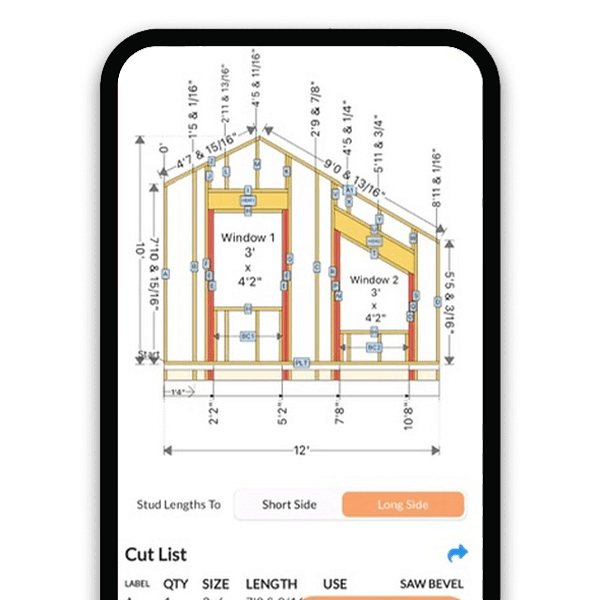
Calculate Every Rake Wall Stud Automatically
Rake Wall Framing FAQ
What is a rake wall?
A rake wall is a framed wall where the top plate follows the slope of the roof instead of running level. You see rake walls at the gable ends of a house where the wall rises to meet the peak of the roof. Every stud in a rake wall has a different height because the top plate is angled, and each stud needs a bevel cut at the top to sit flush against the sloped plate. Rake walls are also called gable walls or gable-end walls.
How do you calculate stud lengths for a rake wall?
Each stud length is calculated from the wall's short side height plus the rise at that stud's position. The formula is: stud length = short wall height + (distance from short end x tangent of roof pitch). For a 6/12 pitch, the tangent is 0.5, so a stud 4 feet from the short end is 2 feet taller than the short wall. The top of each stud also gets a bevel cut matching the pitch angle. A rake wall calculator computes every stud length and angle automatically.
What is the difference between a rake wall and a gable wall?
They are the same thing. A rake wall and a gable wall both refer to a wall with an angled top plate that follows the roof slope at the gable end of a building. The term 'rake' refers to the sloped edge of the roof, and the wall beneath it is the rake wall or gable wall. Some builders also use 'gable-end wall' to describe the same framing.
What is a rake beam?
A rake beam is a structural beam that runs along the slope of the roof at the gable end, typically at the top of the rake wall. It supports the roof overhang (the rake overhang) that extends past the gable wall. Rake beams can be built from dimensional lumber, LVL, or engineered trusses depending on the overhang length and load. In some designs, the rake beam is the angled top plate of the rake wall itself.
How do you cut the bevel angle for rake wall studs?
The bevel angle matches the roof pitch. For a 6/12 pitch, the bevel is 26.57 degrees from square. Set your circular saw or miter saw to this angle and cut the top of each stud. All studs in a rake wall get the same bevel angle - only the lengths are different. Mark the pitch angle on a speed square for quick reference. A rake wall calculator gives you the exact angle for any pitch.
Can I frame a rake wall on the floor and tilt it up?
Yes, and that is the preferred method. Snap a chalk line for the angled top plate on the subfloor, lay out your studs at the correct spacing, cut each one to its calculated length with the bevel at the top, then nail through the plates into the stud ends. Tilt the completed wall up and brace it. This is much more accurate and faster than trying to measure and cut studs one at a time in place.
How do I frame a rake wall with a window?
Frame the window opening the same way as a standard wall - with king studs, jack studs, a header, a rough sill, and cripple studs. The difference is that the cripple studs above the header will have different lengths because they go up to the angled top plate. Position the window in the lower portion of the rake wall where you have enough wall height for the header and the full rough opening.
What roof pitches are common for rake walls?
Common residential roof pitches for rake walls range from 4/12 to 12/12. A 4/12 pitch rises 4 inches for every 12 inches of run (18.4 degrees). A 6/12 pitch (26.6 degrees) is the most common for standard homes. Steeper pitches like 8/12 (33.7 degrees) and 12/12 (45 degrees) are used for Cape Cod, colonial, and A-frame styles. The steeper the pitch, the taller the rake wall at the peak and the greater the difference between stud lengths.
What is a stair rake wall?
A stair rake wall is a wall that runs alongside a staircase, following the angle of the stairs. Like a roof rake wall, the top (or bottom) of the wall is angled rather than level, and each stud has a different length. The pitch of a stair rake wall is determined by the stair rise and run. A rake wall calculator can handle stair rake walls by entering the stair angle instead of a roof pitch.
How is rake framing different from regular wall framing?
In regular wall framing, every stud is the same length and the top plate is level. In rake framing, the top plate is angled to follow the roof slope, so every stud has a unique length and a bevel cut at the top. The bottom plate, stud spacing, and opening framing (headers, jack studs) work the same way. The main challenge is calculating the individual stud lengths correctly - getting one wrong means recutting lumber and wasting material.
Learn More
Frame Your Rake Wall with Confidence
Enter your wall dimensions and roof pitch. Get every stud length, bevel angle, and cut list computed automatically. Export a PDF blueprint and take it to the job site.