

Window Framing & Headers - How to Frame a Window Opening
What is a Header in Construction?
A header is a horizontal beam that spans the top of every door, window, and pass-through opening in a framed wall. Its job is to carry the weight from the roof, floor, or wall structure above the opening and transfer it down through the jack studs to the bottom plate and foundation. Without a properly sized header, the weight above the opening has nowhere to go, and the wall can sag, crack drywall, or even fail structurally.
In residential construction, headers are typically built from two pieces of dimensional lumber (like 2x8 or 2x10) with a 1/2-inch plywood spacer sandwiched between them. This creates a header that matches the wall depth (3.5 inches for a 2x4 wall). For wider spans or heavier loads, engineered lumber like LVL (laminated veneer lumber) or steel beams are used instead of dimensional lumber.
The size of the header board depends on two factors: the width of the opening and whether the wall is load-bearing. Non-load-bearing partition walls can use a flat 2x4 header for most openings. Load-bearing walls need a structural header sized to the span - a doubled 2x6 for openings up to 4 feet, 2x8 for up to 6 feet, 2x10 for up to 8 feet, and 2x12 for up to 10 feet.
Window Header Size Chart
Use this chart to determine the right header size for your window opening. These are common guidelines for standard single-story residential construction. For multi-story homes, heavy roof loads, or spans over 10 feet, consult a structural engineer.
| Opening Width | Load-Bearing Wall | Non-Load-Bearing Wall |
|---|---|---|
| Up to 3 feet | Doubled 2x6 | Flat 2x4 |
| 3 to 4 feet | Doubled 2x6 | Flat 2x4 |
| 4 to 6 feet | Doubled 2x8 | Flat 2x4 or doubled 2x4 |
| 6 to 8 feet | Doubled 2x10 | Doubled 2x4 |
| 8 to 10 feet | Doubled 2x12 | Doubled 2x6 |
| Over 10 feet | LVL beam or steel (engineer required) | Doubled 2x8 or engineer |
Header sizes assume standard single-story residential loading. Always verify with your local building code and a structural engineer for specific conditions.
How to Frame a Window Opening Step by Step
- 1
Determine the Rough Opening Size
Check the window manufacturer specs for the rough opening width and height. Typically the rough opening is the window unit size plus 1/2 inch on each side for shimming.
- 2
Mark and Install King Studs
Position full-height king studs on each side of the opening. These run from the bottom plate to the top plate and define the outer edges of the window frame.
- 3
Cut and Install Jack Studs (Trimmers)
Cut jack studs to the header height and nail them inside the king studs. The jack studs carry the weight of the header and everything above the opening.
- 4
Build and Set the Header
Build the header from doubled lumber sized for the span (see the header size chart above). Set it on top of the jack studs and nail through the king studs into the header ends.
- 5
Install the Rough Sill
Cut the rough sill to fit between the jack studs at the bottom of the window. Nail it to the jack studs. The sill height is determined by the window size plus 1/2 inch.
- 6
Add Cripple Studs Above and Below
Install cripple studs from the header to the top plate and from the rough sill to the bottom plate. Space them to maintain your on-center layout (16" or 24") for sheathing and drywall attachment.
Window Framing Components Explained
King Studs
Full-height studs that frame the sides of the rough opening. They run from the bottom plate to the top plate and provide a nailing surface for the jack studs and the header ends. Every window opening has one king stud on each side.
Jack Studs (Trimmers)
Shorter studs nailed inside the king studs. They run from the bottom plate to the bottom of the header and directly support the header's weight. For wider openings or heavy loads, building codes may require doubled jack studs.
Header
The horizontal beam that spans the top of the opening. In a load-bearing wall, the header carries roof and floor loads across the opening to the jack studs. Headers are built from doubled dimensional lumber with a plywood spacer, or from engineered LVL beams for longer spans.
Rough Sill
A horizontal member at the bottom of the window opening, running between the jack studs. The window unit sits on the rough sill. It does not carry structural load but provides a nailing surface and defines the bottom of the opening.
Cripple Studs
Short studs above the header (to the top plate) and below the rough sill (to the bottom plate). They maintain the wall's stud spacing for sheathing and drywall attachment and transfer minor loads. They are not full-height studs but are required by code at every on-center position within the opening.
Frame Your Window Opening Automatically
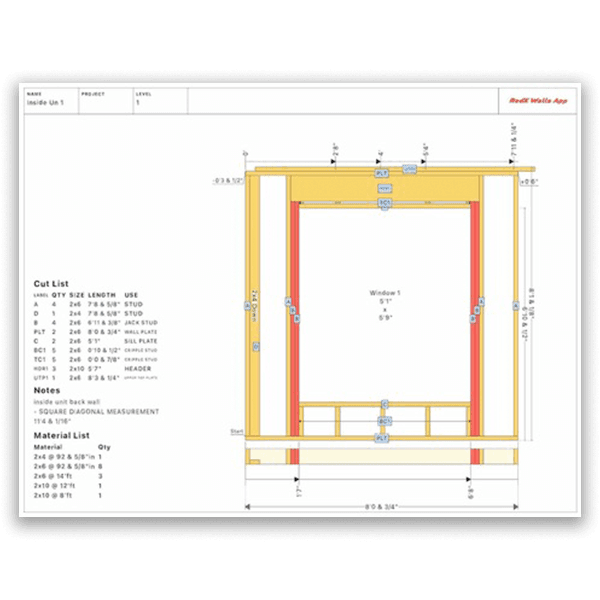
Enter your wall dimensions, add a window, and see the full framing layout with header, king studs, jack studs, cripples, and a complete cut list. Export a PDF blueprint for the job site.
Common Window Framing Mistakes
Undersized headers
Using a header that is too small for the span or load. This causes sagging above the opening, cracked drywall, and windows that stick. Always size the header to the opening width and wall load.
Missing jack studs
Resting the header on a single stud instead of dedicated jack studs. The header needs direct support from trimmers that bear on the bottom plate. Without them, the header can shift or drop under load.
Wrong rough opening size
Making the rough opening too tight or too large. Too tight and the window will not fit. Too large and you will not have enough material to shim and secure the window properly. Always check the manufacturer specs.
Forgetting cripple studs
Skipping cripples above the header or below the sill. Without them, sheathing and drywall have no backing at those stud positions, leading to weak spots and fastener pops.
Plan Your Window Framing Before You Build
Window Framing & Header FAQ
What is a header in construction?
A header is a horizontal structural member that spans the top of an opening in a framed wall - above a window, door, or pass-through. The header carries the weight from the wall, roof, or floor above and transfers it to the jack studs (trimmers) on each side of the opening. Headers are typically made from doubled dimensional lumber (2x6, 2x8, 2x10, or 2x12) with plywood spacers, or from engineered lumber like LVL beams for wider spans.
How do you frame a window opening in a wall?
Start by installing two full-height king studs at each side of the opening. Inside the king studs, install shorter jack studs (trimmers) that support the header. Place the header across the top, resting on the jack studs. Below the window, install a rough sill between the jack studs. Add cripple studs below the sill (from sill to bottom plate) and above the header (from header to top plate) to maintain your on-center stud spacing. The rough opening should be about 1/2 inch wider and taller than the window unit for shimming.
What size header do I need for a window?
Header size depends on the opening width and whether the wall is load-bearing. For load-bearing walls: use a doubled 2x6 for spans up to 4 feet, doubled 2x8 for up to 6 feet, doubled 2x10 for up to 8 feet, and doubled 2x12 for up to 10 feet. Non-load-bearing walls can use a flat 2x4 header for most openings. For spans over 10 feet or walls carrying heavy roof loads, consult an engineer or use an LVL beam. Always verify with your local building code.
What is the difference between a king stud and a jack stud?
A king stud runs the full height of the wall from the bottom plate to the top plate, framing the sides of the rough opening. A jack stud (also called a trimmer) is shorter and sits inside the king stud - it runs from the bottom plate up to the bottom of the header. The jack stud directly supports the header and carries the load from above the opening. Every window and door opening needs at least one king stud and one jack stud on each side.
What is a header board?
A header board is the lumber used to build the header over a wall opening. For residential framing, headers are typically made by sandwiching a piece of 1/2-inch plywood between two pieces of dimensional lumber (like two 2x8s) and nailing them together. This creates a header that matches the wall thickness (3.5 inches for a 2x4 wall). Engineered header boards like LVL (laminated veneer lumber) are used for longer spans where dimensional lumber is not strong enough.
What are cripple studs and where do they go?
Cripple studs are short studs that fill the space above a header (between the header and top plate) and below a window sill (between the sill and bottom plate). They maintain the wall's on-center stud spacing for attaching sheathing and drywall, and they transfer loads to and from the header. Cripple studs are not full-height and do not carry the same load as regular studs, but they are required by code.
How do I determine the rough opening size for a window?
Check the window manufacturer's specifications - every window has a required rough opening size listed on the spec sheet. As a general rule, the rough opening is the window unit width plus 1/2 inch on each side (1 inch total) and the window unit height plus 1/2 inch. This extra space allows for shimming and leveling the window during installation. If you are replacing an existing window, measure the current rough opening before ordering.
Can I frame a window opening in a load-bearing wall?
Yes, but the header must be sized to carry the load from above. In a load-bearing wall, the header transfers roof and floor loads across the opening to the jack studs and down to the foundation. Use a properly sized structural header (doubled 2x8, 2x10, or 2x12 depending on span) and ensure the jack studs bear directly on the bottom plate. For large openings or heavy loads, an engineer may specify an LVL or steel beam. In a non-load-bearing partition wall, a flat 2x4 header is usually sufficient.
How do I frame a window in an existing wall?
First, determine if the wall is load-bearing. If it is, install temporary support walls on both sides before cutting any studs. Mark the rough opening on the wall, then remove drywall and cut out the studs within the opening. Install king studs at each side, then jack studs inside them. Place the header on top of the jack studs and add the rough sill at the bottom. Fill above and below with cripple studs. Patch the drywall around the new framing before installing the window.
What is the standard window header height?
The standard header height in residential construction is 6 feet 10 inches (82 inches) from the subfloor to the bottom of the header. This aligns window and door headers at the same height across the room, creating a uniform look. The actual header height on your plans may differ based on ceiling height, window size, or architectural design. For 9-foot ceilings, header heights are often set at 7 feet 10 inches or 8 feet.
Learn More
Frame Windows with Confidence
Enter your wall dimensions, add windows, and get a complete framing layout with headers sized automatically. Export a blueprint with every king stud, jack stud, and cripple in place.