
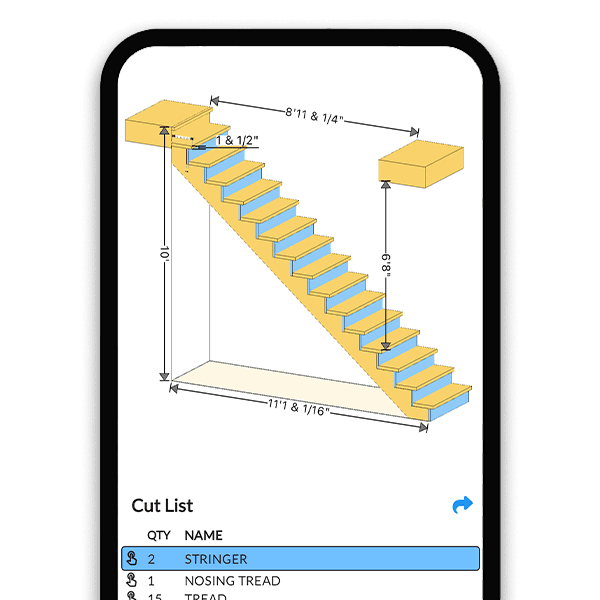
How to Calculate Stair Stringers: Rise, Run, and Layout Explained
By RedX Apps Team · Published 2026-07-19 · Editorial policy
What Is Total Rise and How Do You Measure It?
Total rise is the vertical distance from the finished floor at the bottom of the stairs to the finished floor at the top. Measure it with a level and tape, not by adding up framing lumber, because subfloors, underlayment, and finish flooring all change the number. If the finish floor is not installed yet, add its thickness to your measurement so the top and bottom steps end up equal after finishing.
On uneven ground, such as a deck stair landing on grade, level out from the top landing to a point directly above where the stairs will land, then measure straight down. A 1/2 inch error in total rise turns into a code violation at the top or bottom riser, so take this measurement twice.
How Do You Calculate the Number of Risers and Riser Height?
Divide the total rise by 7.5 inches, a comfortable target riser height, and round to the nearest whole number. That gives you the riser count. Then divide the total rise by that count to get the exact riser height. Every riser in the flight must be this exact height; the IRC allows no more than 3/8 inch variation between the tallest and shortest riser in a flight.
The riser count also fixes the tread count: a stringer always has one fewer tread than risers, because the top landing acts as the final step. Fourteen risers means thirteen treads.
- Riser count - Total rise divided by 7.5, rounded to the nearest whole number.
- Exact riser height - Total rise divided by the riser count. Keep it at or below 7-3/4 inches for IRC residential compliance.
- Tread count - Riser count minus one.
What Is the 7-11 Rule for Stairs?
Carpenters use two rules of thumb to keep stairs comfortable. The 7-11 rule says a roughly 7 inch riser paired with an 11 inch tread produces a natural stride. The second is the classic comfort formula: two times the riser plus the tread should equal 24 to 25 inches (2R + T = 24-25). A 7.5 inch riser with a 10 inch tread gives 2(7.5) + 10 = 25, right at the top of the comfort band.
Code sets the outer limits, comfort rules set the target. The IRC caps risers at 7-3/4 inches and requires treads at least 10 inches deep for residential stairs, but always verify with your local building department, since some jurisdictions amend these numbers.
Worked Example: Calculating Stringers for a 105 Inch Total Rise
Say you measure a total rise of 105 inches from finished floor to finished floor. Divide by 7.5 to get 14, a whole number, so the flight needs 14 risers at exactly 105 / 14 = 7.5 inches each. With 14 risers you have 13 treads. Choose a 10 inch run per tread, which satisfies both the IRC minimum and the comfort formula.
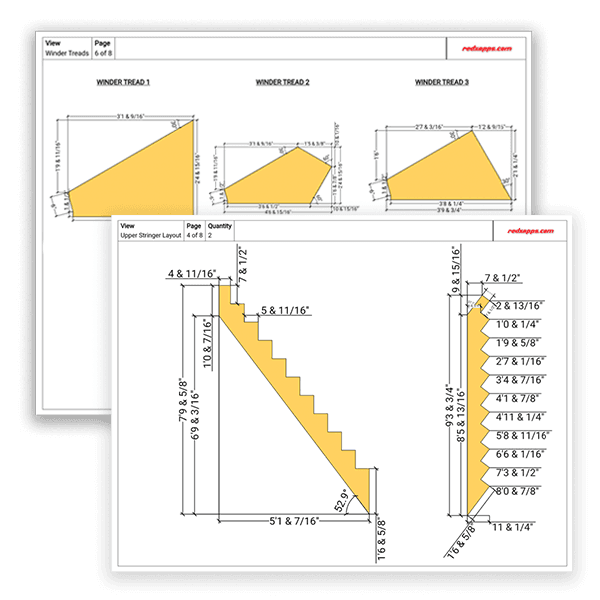
Total run is treads times run: 13 x 10 = 130 inches. The stringer length comes from the Pythagorean theorem: the square root of (total rise squared plus total run squared), or sqrt(105^2 + 130^2) = sqrt(11025 + 16900) = sqrt(27925), about 167.1 inches. That means each stringer needs a board at least 14 ft long, so plan on 16 ft stock. The RedX stair builder performs this whole chain of math from a single total rise input and prints the stringer layout with every rise and run marked.
| Value | Formula | Result |
|---|---|---|
| Riser count | 105 / 7.5, rounded | 14 risers |
| Riser height | 105 / 14 | 7.5 inches |
| Tread count | 14 - 1 | 13 treads |
| Total run | 13 x 10 inches | 130 inches |
| Stringer length | sqrt(105^2 + 130^2) | 167.1 inches |
Why Do You Drop the Stringer by One Tread Thickness?
After laying out the stringer, cut the bottom of it shorter by exactly one tread thickness. Here is why: once you install treads, every step gains the tread thickness in height, except the very first one measured from the floor. Without the drop, the bottom riser would be one tread thickness taller than all the others and the top riser one tread thickness shorter. Dropping the stringer restores equal risers through the whole flight.
If the bottom of the stairs lands on a finished surface but the stringer sits on subfloor, adjust for that difference too. This is the single most common stringer mistake, and it is one the RedX calculator handles for you by asking for tread thickness and finished floor conditions up front.
How Much Wood Must Remain on a Cut Stringer?
When you notch a 2x12 for treads and risers, the uncut wood between the inside corner of the notch and the back edge of the board is called the throat. Most codes and engineering guides call for a minimum throat depth of about 5 inches; anything less and the stringer can split along the grain under load. A 2x12 with a 7.5 inch rise and 10 inch run typically leaves a throat just over 5 inches, which is why 2x12s are the standard stringer stock and 2x10s generally are not deep enough for cut stringers.
Use three stringers for stairs up to 36 inches wide with 2x lumber treads, and add more for wider stairs or thinner tread material. Solid (housed) stringers carry treads in routed dadoes and keep the full board depth, which is why they can span farther.
Let the Calculator Mark Your Stringers
Frequently Asked Questions
What is the formula for calculating stair stringers?
Divide the total rise by 7.5 to get the riser count (rounded to a whole number), then divide the total rise by that count for the exact riser height. Multiply the tread run by the number of treads (risers minus one) for total run. Stringer length is the square root of total rise squared plus total run squared.
How many stringers do I need for a set of stairs?
Use at least three stringers for stairs up to 36 inches wide with 2x lumber or two layers of 5/4 decking as treads. Wider stairs or thinner tread material need stringers every 12 to 16 inches on center. Two stringers are only acceptable on very narrow stairs with thick, solid treads.
What size lumber should I use for stair stringers?
Use 2x12s for cut stringers. Notching for a 7.5 inch rise and 10 inch run leaves a throat of roughly 5 inches on a 2x12, which is generally the minimum for strength. A 2x10 usually leaves too little wood after notching and should only be used as a solid or housed stringer.
How long of a board do I need for a stair stringer?
Calculate the diagonal with the Pythagorean theorem: square the total rise, square the total run, add them, and take the square root. For a 105 inch rise and 130 inch run, that is about 167 inches, so you would buy 16 ft stock. Always add a little extra for the top and bottom cuts.
Why do you cut the bottom of a stair stringer shorter?
You drop the stringer by one tread thickness because installing treads raises every step except the first one off the floor. Without the drop, the bottom step would be too tall and the top step too short by exactly one tread thickness, violating the 3/8 inch riser uniformity limit in the IRC.
What is the maximum riser height allowed by code?
The IRC limits residential risers to 7-3/4 inches maximum, with no more than 3/8 inch variation between the largest and smallest riser in a flight. Commercial stairs under the IBC are stricter, typically 7 inches maximum. Always verify with your local building department, since jurisdictions can amend these limits.
Can a calculator lay out stair stringers for me?
It can, and the biggest payoff is error prevention. The mistakes that ruin stringers, forgetting the tread-thickness drop, rounding riser heights unevenly, buying stock too short, are exactly what the RedX stair calculator eliminates: from a single total rise it computes riser count, exact riser height, total run, and stringer length, applies the drop automatically, and hands you a dimensioned layout to cut from.
Learn More
Calculate Your Stringers in Seconds
Skip the framing-square trial and error. The RedX stair calculator turns your total rise into a code-checked stringer layout with a cut list and printable blueprint.